
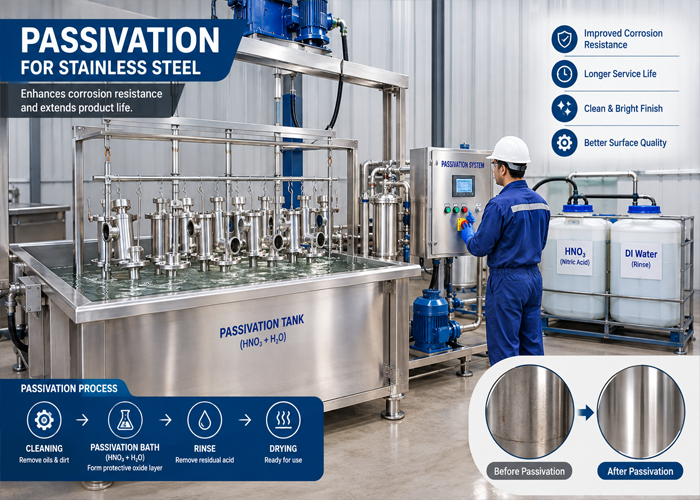
Enhance the corrosion resistance of your stainless steel equipment through professional passivation — the final shield that meets Standard audit requirements.
Passivation is a chemical treatment process that enhances the natural corrosion resistance of stainless steel by promoting the formation of a thin, dense, and self-healing chromium oxide layer on the surface.
Stainless steel gets its "stainless" property from chromium — when exposed to oxygen, chromium forms an invisible protective oxide film (Cr₂O₃). Passivation uses a mild oxidizing acid to maximize this chromium oxide layer, remove any free iron from the surface, and ensure uniform corrosion protection across the entire equipment surface.
Understanding the three-phase mechanism that transforms an ordinary SS surface into a corrosion-resistant shield.
The mild acid dissolves free iron particles and other foreign material embedded in the surface during fabrication, machining, or handling. This iron, if left untreated, would become rust initiation points.
The oxidizing nature of the acid (nitric or citric) enriches the chromium content at the surface by selectively dissolving iron while leaving chromium behind. This creates a chromium-rich zone.
When exposed to air or the oxidizing acid itself, the chromium-rich surface instantly forms a thin (1-3 nm), dense, transparent chromium oxide (Cr₂O₃) passive film — the ultimate protective shield.
A carefully controlled procedure ensuring optimal passive film formation on every surface.
Remove all oils, grease, adhesives, and organic contaminants using alkaline or solvent cleaners. Surface must be completely clean.
Thorough water rinse to eliminate all traces of cleaning agents. Any residual cleaner can interfere with the passivation chemistry.
Immerse or circulate nitric acid or citric acid solution at controlled concentration, temperature, and contact time per ASTM A967.
Multiple water rinses to completely remove acid from all surfaces, crevices, and internal passages of the equipment.
Perform verification tests (copper sulfate, ferroxyl, or free iron test) to confirm the surface is free of free iron and properly passivated.
Air dry or wipe dry with clean lint-free cloths. Issue passivation certificate with process parameters and test results.
We offer both nitric acid and citric acid passivation methods, selecting the optimal one based on your equipment, industry, and compliance requirements.
For pharmaceutical equipment, we recommend Nitric Acid Passivation (Method 1) as it is the most widely accepted method under Standard audit protocols and ASTM A967.
| Method | Solution | Conditions | Best For |
|---|---|---|---|
| Nitric Acid (Type 1) Recommended |
20–25% HNO₃ by weight | Room temp to 49°C 30–60 minutes |
Pharma equipment, Standard compliance, most common industrial use |
| Nitric Acid (Type 2) Standard |
20–40% HNO₃ + 2–6% Na₂Cr₂O₇ | 49–60°C 15–30 minutes |
Heavily contaminated surfaces, post-pickling treatment |
| Nitric Acid (Type 6) Standard |
20–50% HNO₃ with sodium dichromate |
Room temp 30 minutes |
General purpose, moderate contamination levels |
| Citric Acid Alternative |
4–10% Citric Acid | 49–71°C 15–60 minutes |
Eco-friendly option, food industry, where nitrate disposal is a concern |
| Electro-polishing Assisted Specialized |
Phosphoric + Sulfuric acid electrolyte | Controlled voltage & temp | Ultra-high purity requirements, semiconductor, biotech |
We don't just passivate — we prove it. Every job undergoes rigorous testing to verify the passive film integrity.
Apply CuSO₄ solution — no copper deposition on properly passivated surface. Quick visual verification.
Ferrocyanide + nitric acid solution reveals free iron as blue spots. No spots = successful passivation.
Immerse in DI water for 24 hours. Check for rust formation. Per ASTM A967 — pass if no rust visible.
Extended corrosion test in salt spray chamber (ASTM B117). Confirms long-term passive film performance.
Electrochemical measurement of pitting potential. Most accurate lab test for critical pharmaceutical applications.
On-site spot test using commercial test solutions. Quick field verification before and after passivation treatment.
Auger Electron Spectroscopy (AES) or XPS to measure chromium-to-iron ratio — confirms chromium enrichment at surface.
Complete passivation certificate with process parameters, test results, and compliance statement for audit records.
Passivation is typically the final chemical treatment — it works best on a clean, pickled, and properly finished surface.
Important: Passivation alone cannot remove weld scale or heat tint. For welded equipment, pickling must be done first. We offer the complete workflow — buffing → pickling → passivation — as an integrated package.
Creates the thickest, most uniform chromium oxide layer possible, maximizing the inherent corrosion resistance of the stainless steel grade.
Passivation is a mandatory requirement in Standard-regulated pharmaceutical facilities. Our certified process and documentation ensure audit readiness.
Unlike pickling, passivation does not remove any metal or change the surface finish, dimensions, or appearance of the equipment.
The chromium oxide film is self-healing — if scratched or damaged, it naturally regenerates when exposed to oxygen, providing ongoing protection.
Properly passivated equipment lasts significantly longer in corrosive pharmaceutical and chemical environments, reducing replacement costs.
The passive film creates a smooth, non-reactive surface that resists product adhesion and makes CIP/SIP cleaning processes more effective.
Our passivation process strictly adheres to internationally recognized standards.
Standard specification for chemical passivation treatments for stainless steel parts — our primary compliance standard.
Standard practice for cleaning, descaling, and passivation of stainless steel parts, equipment, and systems.
Aerospace Material Specification for passivation of corrosion-resistant steel — applicable for high-purity requirements.
Standard practice for operating salt spray (fog) apparatus — used for extended corrosion verification testing.
Compliance with Standard Code of Federal Regulations for equipment surface finish in pharmaceutical manufacturing.
Quality management system ensuring consistent process control, documentation, and traceability for every passivation job.
We come to your facility for large fixed equipment — vessels, pipelines, and connected systems.
Small parts, fittings, and components treated in our Ankleshwar facility with immersion tanks.
Pump-through method for pipework and internal surfaces that can't be reached by immersion or spray.
Get a free consultation and certified passivation treatment for your stainless steel equipment. We provide full documentation for your Standard audit records.