
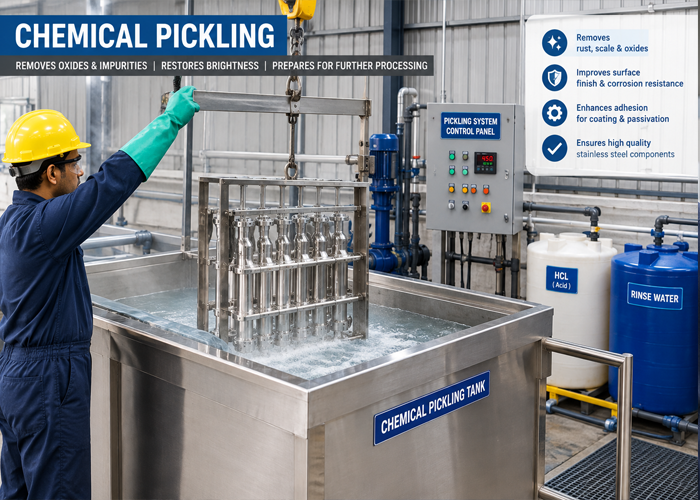
Professional chemical pickling process to remove impurities, stains, weld scale, and heat tint from stainless steel surfaces — ensuring clean and corrosion-free finish.
Chemical Pickling is a chemical surface treatment process that uses acid solutions to remove impurities, stains, rust, scale, and weld-induced discoloration (heat tint) from stainless steel surfaces. It is one of the most critical pre-treatment steps in the metal finishing workflow.
During welding, fabrication, and heat treatment, stainless steel develops an oxide layer (heat tint) and a depleted chromium zone beneath it. If left untreated, this layer significantly reduces corrosion resistance. Pickling removes both the oxide layer and the underlying depleted chromium, restoring the steel's full corrosion-resistant properties.
Welding and fabrication leave behind invisible threats to stainless steel — here's what happens if pickling is skipped.
Welding creates an oxide discoloration zone (heat tint) ranging from straw to blue-black, indicating chromium depletion beneath the surface.
Heat tint zone loses chromium — the element that gives stainless steel its corrosion resistance. The underlying layer becomes susceptible to rust.
Welding deposits slag, spatter, and iron-rich scale that cannot be removed by mechanical cleaning alone and will cause pitting corrosion.
Unpickled welds fail Standard and other regulatory audits due to surface roughness, contamination risk, and non-compliance with cleanability standards.
A controlled, multi-stage chemical treatment ensuring complete removal of contaminants while protecting the base metal.
Degreasing and removal of oils, grease, and loose contaminants using alkaline or solvent-based cleaners.
Thorough rinsing with clean water to remove all cleaning agents and prevent chemical interference with the pickling acid.
Application of nitric-hydrofluoric acid blend to dissolve oxide layer, weld scale, and depleted chromium zone from the surface.
Immediate and thorough water rinsing to halt the acid reaction and wash away dissolved metal salts and residual acid.
Treatment with alkaline neutralizing solution to eliminate any remaining acid traces and bring the surface pH to neutral level.
Final DI water rinse followed by air drying or wipe drying, preparing the surface for passivation or further finishing.
We use carefully formulated acid blends optimized for different stainless steel grades and contamination levels — always in compliance with ASTM standards.
Acid concentration, temperature, and dwell time are customized based on the steel grade, extent of oxidation, and equipment geometry.
| Solution Type | Composition | Application | Standard |
|---|---|---|---|
| Pickling Paste | HNO₃ + HF | Weld seams, localized areas, vertical surfaces | ASTM A380 |
| Pickling Gel | HNO₃ + HF + Thickener | Overhead surfaces, pipes, complex geometries | ASTM A380 |
| Pickling Liquid | HNO₃ + HF (Diluted) | Immersion pickling of small parts & fittings | ASTM A380 |
| Spray Pickling | HNO₃ + HF (Spray Grade) | Large flat surfaces, vessel exteriors | ASTM A380 |
| Degreaser | Alkaline Solution | Pre-cleaning to remove oils & grease | ASTM A380 |
| Neutralizer | Sodium Bicarbonate | Post-pickling acid neutralization | ASTM A967 |
The difference is visible — and critical for equipment performance and regulatory compliance.
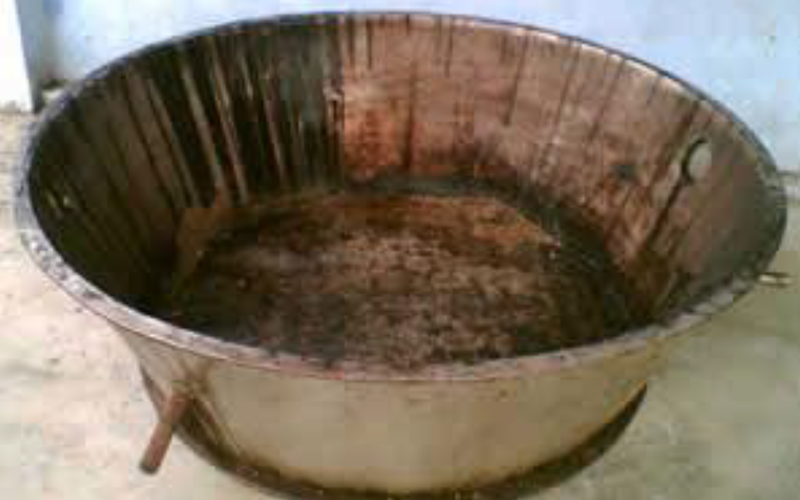
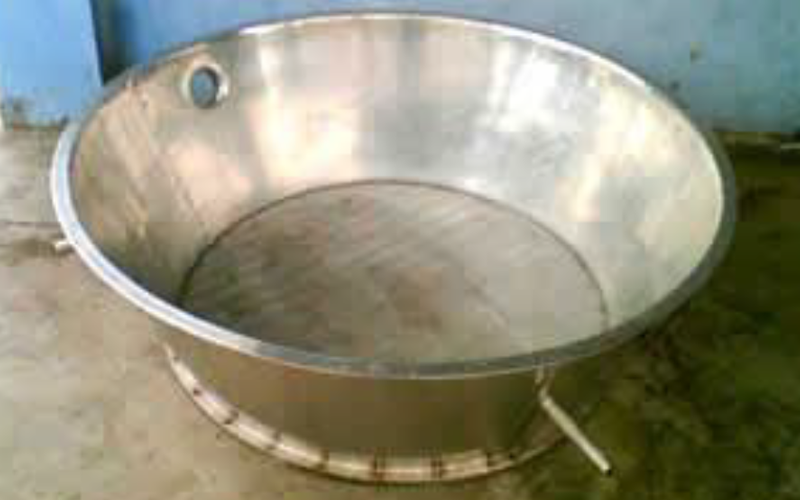
Brush-applied paste for weld seams and localized treatment areas on large equipment.
Full immersion in pickling bath for small parts, fittings, elbows, and batch processing.
Spray application for large flat surfaces, vessel exteriors, and sheet metal processing.
Pumping pickling solution through pipes and tubing for internal surface treatment.
Removes the chromium-depleted layer and restores the full corrosion-resistant properties of stainless steel as intended by the material specification.
Pickled welds and surfaces meet the cleanability and surface quality requirements essential for passing pharmaceutical regulatory audits.
Pickling is the essential pre-treatment step — passivation cannot be effective on a surface that still has heat tint or depleted chromium.
Eliminates discoloration and provides a uniform, clean metallic appearance across the entire equipment surface including all weld zones.
Chemical pickling is faster and more economical than mechanical methods for treating multiple welds and large surface areas simultaneously.
By restoring the protective chromium oxide layer, pickling significantly extends the service life of stainless steel equipment in corrosive environments.
Chemical pickling involves hazardous acids — we follow strict safety protocols to protect our team, your equipment, and the environment.
Acid-resistant gloves, face shields, chemical-resistant aprons, rubber boots, and respiratory protection worn by all operators during pickling operations.
Adequate ventilation, local exhaust systems, and fume extraction to manage nitric acid fumes (NOx gases) generated during the pickling reaction.
Spent pickling solutions are neutralized and treated before disposal. Dissolved metals (Cr, Ni, Fe) are precipitated and handled per environmental regulations.
Complete Material Safety Data Sheets, process records, and compliance documentation maintained for every project as per ASTM A380 / A967 standards.
These are complementary but distinct processes — both are often needed for optimal results.
Recommendation: For welded pharmaceutical equipment, we always recommend pickling first to remove heat tint, followed by passivation to maximize the protective oxide layer.
Get a free consultation and detailed quote for your pickling requirements. We handle everything from small fittings to full-sized vessels.